FREE ADMISSION
PROGRAM:
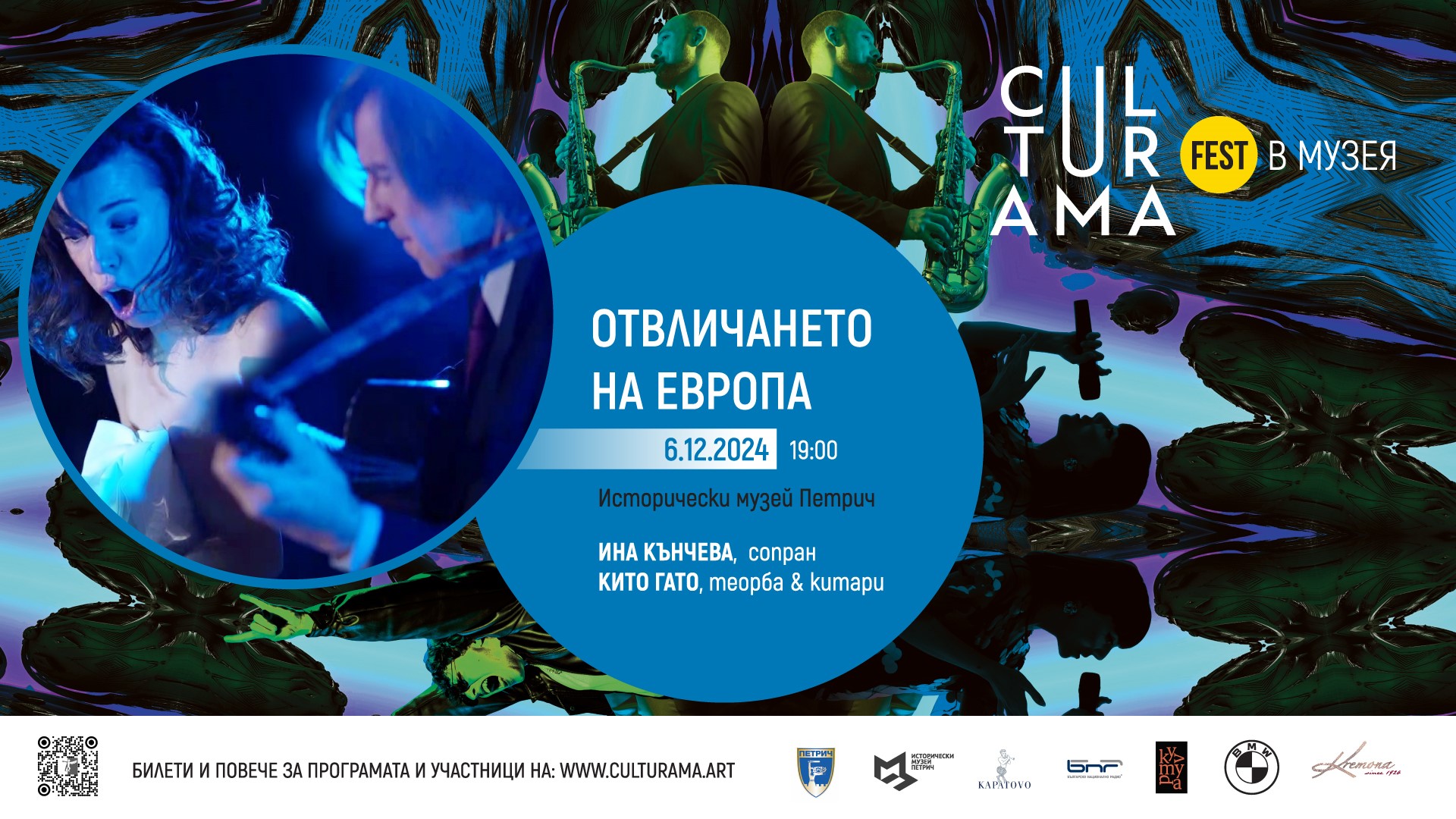
INA KANCHEVA soprano
KITO GATO theorbo and guitars
Barbara Strozzi / 1619 - 1699
Lagrime mie
Giulio Caccini / c.1550 - 1618
Dalla porta d’oriente
Gaspar Sanz / 1640 - 1710
Canarios
José Marín / 1619 - 1699
Ojos pues me desdeñáis
Pepe Justicia/1960-
Fandango de Huelves
Federico García Lorca / 1898 - 1936
Los cuatro muleros
Nana de Sevilla
Manuel de Falla / 1876 - 1946
Canción del Fuego Fatuo
Anonymous Sepharade
Morenica a mi me llaman
Anonymous - Venezuela
Malagueña
Aníbal Troilo / 1938 – 1975
Malena
Lucilla Galeazzi/ 1950-
Quante stelle nel cielo con la luna
George Enescu /1881-1955
Languir me fais
Zoltan Kodaly /1882-1967
A csitári hegyek alatt
Stefan Diomov/ 1945-
Звезда ( A star)
Encores:
Michel Legrand /1932-2019
Les Moulins de mon Coeur
Chabuca Grande – Perú / 1920 - 1983
La flor de la canela
Mercedes Sosa/ 1935-2009
Zamba para non morir
Ariel Ramirez/ 1921-2010
Alfonsina y el Mar
Translated with DeepL.com (free version)
THE KIDNAPPING OF EUROPE
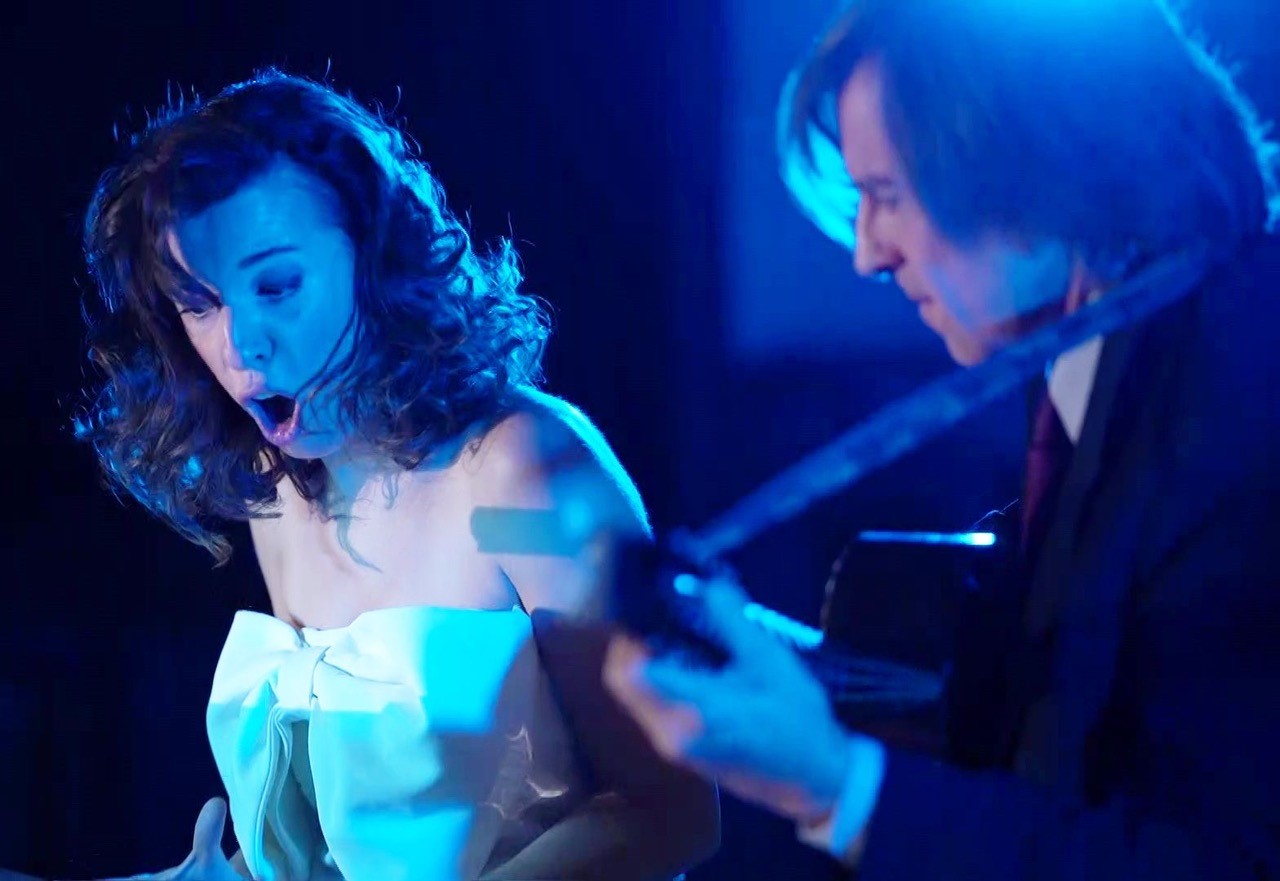
Singer Ina Kancheva and guitarist Kito Gato combine their creativity to embark on a journey they symbolically call "The Abduction of Europa." Passing through Spanish and Italian vocal music from the 17th to the 20th century and mixing with other flourishing melodies from different styles and influences, they present a concert of poetic allegory and passionate synergy between voice and guitar, just like Zeus' seduction and abduction of Europa, reminiscent of and metaphorical bridge to Rembrandt's famous painting "The Abduction of Europa."
The intensity and significance of European art can be explained hermeneutically by the fusion of different cultures and what results from this encounter. For example, three cultures united in Al-Andalus lived together in harmony and with special freedom of religious practice—Christians, Moors, and Jews were the main characters in a progressive and tolerant society that resembled an earthly paradise. An encounter that made a great contribution to humanism and opened the door to the great European Renaissance. Along with philosophy, alchemy, astronomy, arithmetic, and music, the sensuality of Arab culture transformed every aspect of life into a work of art. The enchantment of flavors, aromas, beautiful nuances, and the huge variety of spices are a palette of elements that refine the senses. During this time, the musical field expanded and merged at various points. The Visigoths of Balkan origin, the Jews who expanded their Mosaic law even before Christ, and the Muslims who landed on the Algeciras Peninsula in the 6th century came together in a magnificent blend of different cultural traditions. Mysticism, Kabbalah, and the mystery of pagan rituals associated with Christianity contributed to an exciting meeting of writers and poets, which created a great precedent for the development of the European and then the universal world through transoceanic voyages in the 15th century. A few metrical steps and a wide variety of rhymes characterize not only contemporary Spanish poetry with its distinctive structures, but also other languages with Latin roots such as French or Italian. These traditions, which glorify the five senses and are the product of this wonderful social and cultural framework, will remain indelible beyond the political and territorial changes of the vast empire. In the same year, 1492, the Jews were expelled and the Moors were defeated in the conquest of the city of Granada, leaving an indelible mark on every city on the peninsula. Many words of Nasrid or Jewish origin are now part of the normal Spanish vocabulary. Food, traditions, clothing, songs, dances, pagan festivals, and special celebrations. All of this spread to all the territories that later passed to the Crown, such as Naples and Southern Italy, the four centuries of domination in Latin America, as well as the Flemish territory of the Netherlands during the reign of Charles V (perhaps this is one of the ways that gave its name to the musical genre that today represents Spain in the world, flamenco, which is now part of the intangible cultural heritage of humanity). Music and songs have told the story of these journeys and their countries. Sea voyages and long mountain roads have filled family traditions with legends and emotions. Centuries of exchange and change that will remain forever in this mysterious period around Europe.
INA KANCHEVA
Born in Sofia, she has been devoted to art since the age of six. Ina has already traveled the world as a soloist with the renowned Bulgarian National Radio Children's Choir. She graduated from a high school specializing in theater and visual arts. At the age of 19, she began studying opera singing at the State Music Academy in Sofia and completed a master's degree with her teachers in Italy and Spain. She has won numerous awards in several important international competitions such as Monserrat Caballe, As.Li.Co, Viotti, Manuel Ausensi, DEBUT, and others. Ina Kancheva has been a member of the ensembles of the State Opera in Hanover and Stuttgart in Germany. She is now based in Berlin. She has also accepted invitations from opera houses such as the Royal Opera, Covent Garden, La Scala in Milan, the Royal Danish Opera (Copenhagen), and Palau de les Arts Reina Sofia (Valencia). Ina Kancheva is a regular guest at international music festivals such as the Festival de musique Baroque d'Ambronay (France), Rossini Opera Festival (Italy), and Prague Spring International Music Festival (Czech Republic), among others. Ina works with renowned orchestras and conductors such as Sir Neville Marriner, Vladimir Jurowski, Vasily Petrenko, Cornelius Meister, Enrique Mazzola, Manfred Honeck, Alberto Zedda, Gianluigi Gelmeti, Jiří Bělohlávek, Julia Jones, and René Jacobs, among others. She released her CD Pauline Viardot on Toccata Classics with pianist Ludmil Angelov.
As part of Deutschlandfunk Kultur Berlin's production, Ina took on the role of Madame Landru in Roberto Hazon's unknown chamber opera Madame Landru and began an artistic relationship with the Rundfunk-Sinfonieorchester Berlin (RSB) with numerous recordings and concerts. She produces her own festival, CULTURAMA Fest, and promotes national scholarships for young artists in her native Bulgaria.
QUITO GATO
Born in Buenos Aires, Argentina, Quito Gato began his piano and guitar studies at the National
Conservatory of Music. He then went on to study orchestral conducting, composition,
flute, and percussion in his home country, then in Santiago de Chile, Brazil, Curitiba, and Boston.
Since 1992, he has been studying early music under the guidance of Hopkinson Smith and Eduardo
Eges. Since then, he has performed as a director, soloist, and member of various
ensembles in major theaters in South America, the United States, and Europe. He has
extensively toured Asia to promote Spanish-American Baroque music in Israel, Malaysia,
Thailand, Indonesia, and India. In 2020, he obtained a master's degree in oral translation from the
Haute École de Musique de Genève under the guidance of Monica Pustylnik. I have
participated in numerous chamber and orchestral music projects and have been one of the
founding members of Cappella Mediterranea since 2007. Since 2000, he has made
numerous critically acclaimed recordings of music from the Middle Ages to the Baroque, as well as
works of popular origin from the Mediterranean and Latin America, for Alpha,
Labels Ricercar, Naïve, Virgin, Cantus, and Sony. He regularly collaborates with renowned
ensembles such as L’Arpeggiata, Le Concert d’Astrée, Les Musiciens du Louvre, Le Poème
Harmonique, Le Concert de la Loge, and The Rare Fruits of Council, among others. He has
performed in major theaters and festivals around the world, such as Lincoln Center &
Carnegie Hall, New York, the National Auditorium in Madrid, Palau de la Música Catalana,
Barcelona, the Auditorium of Radio France and the Opéra Garnier, Paris, the Teatro Colón, Buenos Aires, and
the Teatro alla Scala in Milan. He has given master classes in lute and early music in
Argentina, Brazil, France, Italy, and South Korea. As a composer and arranger, he has worked
for various institutions such as Radio France, the Gulbenkian Foundation, RTVE Spain, and
artists such as Sonya Yoncheva, Anne-Sophie von Oter, Nuria Rial, Philippe Jaroussky,
Kristina Pluhar, and Leonardo García Alarcón, among others. Since 2021, he has been a
professor of lute and chamber music at the Cité de la Musique et de la Danse Conservatory
in Strasbourg, France.