Works from the Sephardic and Andalusian repertoire
Federico García Lorca, Manuel de Falla, Juan Hidalgo, José Marin, Barbara Strozzi, and others.
Al Aire Español
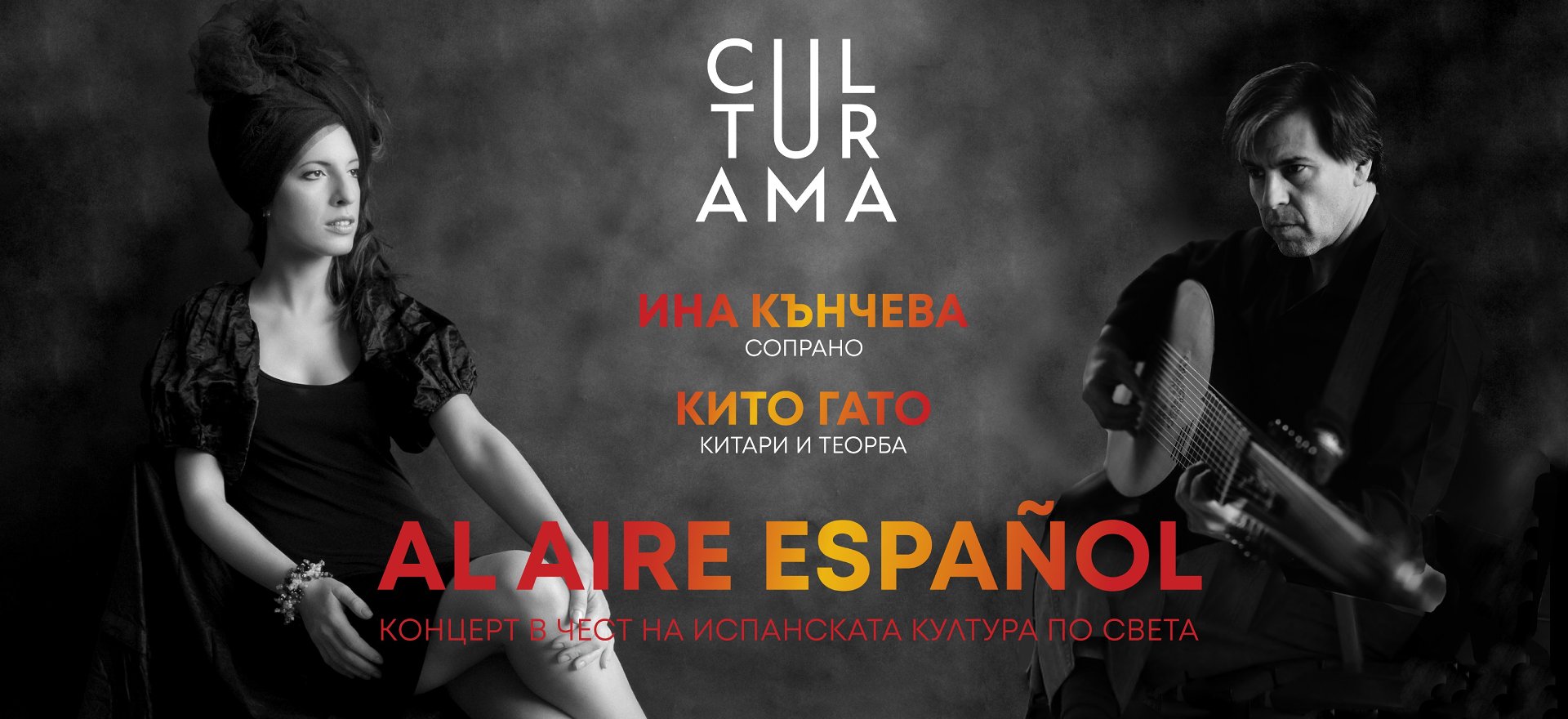
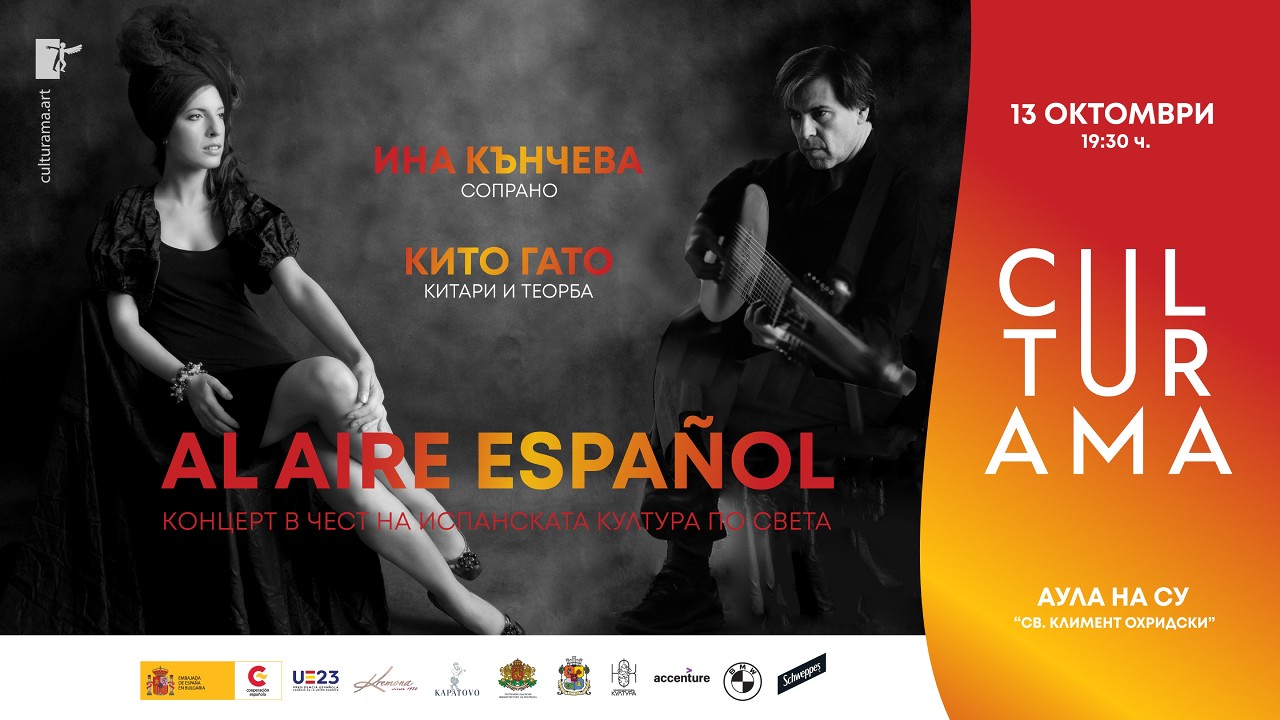
The CULTURAMA Festival presents the latest musical project by the Cultural Perspectives Foundation. Come to a concert in honor of Spanish culture around the world, with the Spanish Embassy in Bulgaria as patron, on the occasion of Spain's Presidency of the Council of the EU.
Program:
Giulio Caccini / c.1550 - 1618
Dalla porta d’oriente
Torna, deh torna
Juan Hidalgo / 1614 - 1685
Esperar, sentir, morir
Girolamo Kapsberger / 1619 - 1699
Figlio dormi
Corrente - Capona
Barbara Strozzi / 1619 - 1699
Lagrime mie
José Marín / 1619 - 1699
Ojos pues me desdeñáis
Gaspar Sanz / 1640 - 1710
Canarios
Federico García Lorca / 1898 - 1936
Nana de Sevilla
Los cuatro muleros
Manuel de Falla / 1876 - 1946
Nana
Canción del Fuego Fatuo
Pedro Herrera (1910 – 1979)
Zorzal Herido
Talya G.A Solan / Aviv Bahar
The secret
Anonym Sepharade
Morenica a mi me llaman
Aníbal Troilo / 1938 – 1975
Malena
Anónimo - Venezuela
Malagueña
Ariel Ramírez – Félix Luna
Alfonsina y el mar
Chabuca Granda – Perú / 1920 - 1983
La flor de la canela
Singer Ina Kancheva and guitarist Kito Gato come together to embark on a journey entitled “AL AIRE ESPAÑOL” through Spanish and Italian vocal music from the 17th to the 20th century.
The unique intensity of all Spanish art can be explained by the explosion between different cultures and the possibilities of their unification – from the Moorish south, through the spiritual energy of the heart of Spain – Galicia, to the mystical north. The three cultures came together in Al Andalus, where all three religions coexisted in harmony and enjoyed freedom of worship. Andalusian civilization—intercultural and tolerant, a paradise on earth not only for the senses but also for the mind—made a significant contribution to humanism and the Renaissance in Europe. Along with the rediscovery of ancient philosophy, logical thinking, astronomy, optics, and alchemy, the cultivation of a rich sensibility was no less significant. The elevated, bright, but above all sensual Moorish culture transformed every aspect of life into a work of art. The enchantment of fragrances, cosmetics, wonderful tinctures, the huge variety of spices, their combination like colors on a palette, refined the senses with their exquisite abundance. Different musical traditions blend together and give rise to a new style – flamenco. The dance, singing, and guitar in this music of "non-possession" are the quintessence of pure emotions bursting forth from the depths. But earthly reality is ephemeral... The passionate longing for the higher reality of God fills not only the poetry of Eastern mystical poets (Bayazid: "I am the one who drinks the wine, the wine, and the cupbearer"). In the Alhambra—a wonderful space for contemplation and meditation—the dizzying complexity and perfect balance in the flow of repeating motifs and arabesques "unravels" the monolithicity of the structure. The water reflections make the heavy towers, columns, and arches fragile, crystallizing into infinity like splashes of water... Every story has its lights and shadows. Despite the petrifying austerity and control of militant Catholicism, in Spanish cathedrals the altar, densely decorated with figures of saints and ornaments, recalls the Moorish horror of empty space. The conflict that gave rise to Spain's most dramatic art in the 16th and 17th centuries ignited an obsession with mystical ecstasy. In El Greco's artistic visions, the fluidity of forms is a visible manifestation of spiritual electricity, an exaltation of light in bodies, in the landscape of Toledo... The mystical and the sensual simultaneously and identically fertilize the Spanish imagination in the centuries to come, thus becoming a source of inspiration for performers as well.
The first part of the concert program consists mainly of music related to sacred and secular texts, commissioned by feudal courts, performed for a small audience, as well as compositions for the Catholic Church, which were intended to represent religious holidays.
Giulio Caccini (1551–1618) was a composer of musical historical significance at the Medici court in Florence, who played a major role in the creation of the first opera, Daphne. His monodic-recitative style of singing had a significant influence on the development of music in the 17th century. You can hear his song "Dalla porta d'oriente" and the aria "Torna, deh torna," the latter being in a distinctly syllabic-coloratura style. The dance song "Esperar, sentir, morir" by Spanish composer Juan Hidalgo (1614–1685) gives an idea of his style. Hidalgo enjoyed great prestige at the Spanish court. He composed theatrical music and operas, among other things, and was a friend of the playwright Calderón de la Barca. In addition, two compositions by Barbara Strozzi (1619–1677) are presented – she was the illegitimate daughter of the important poet and librettist Giulio Strozzi. Strozzi belonged to a group of influential intellectuals in Venice and was a friend of Claudio Monteverdi. Even as a child, Barbara Strozzi came into contact with many Venetian poets and musicians.
She trained as a singer and developed her skills as a self-taught musician under one of the most innovative composers in the field of instrumental chamber music in the mid-17th century. We present the moving lament from her cantata "Lacrime mie."
Girolamo Kapsberger (1580–1651) spent his youth in Venice, was of Austrian noble descent, and, thanks to his extensive connections, gained access to the highest social circles in Rome. His patron, Cardinal Francesco Barberini (nephew of Pope Urban VIII), put him in charge of major church and secular music projects. Kapsberger was considered one of the best theorbo players of his time, regardless of his talent as a composer. As a composer, he left behind sacred and secular vocal works, stage works, and instrumental music. His most popular vocal works are the Villanelles, of which we present "Figlio dormi" and "Cinta di rose."
The life of Spanish composer José Marin (1619–1699) revolved around the periphery of feudal society, and he was involved in crimes on several occasions. Marin did not receive commissions from the court like his contemporary Juan Hidalgo. Even stranger is that in an obituary in the Gaceta de Madrid (1699), his importance as a composer is highly praised. Only his secular compositions have been preserved. The concert program includes from his 60 tonos: the canzonets Ojos, pues me desdenais.
Gaspar Sanz (1640–1710), a native of Aragon, was a guitarist, teacher, and composer. He was the guitar teacher of the Infante Don Juan. The composition for solo guitar "Canarios" is his.
The composition "Convidando esta la noche" by Mexican composer Juan García de Zespédes (1619–1678) is written in madrigal style, with sustained notes between constantly repeating rhythmic-melodic phrases, reminiscent of 20th-century minimalist music.
Musical culture reflects social life and its hierarchical order. With the processes of social change in the 19th and 20th centuries, the function of music and music-making also changed.
The second part of the concert program features music from the 19th and 20th centuries, which is addressed to different social groups of listeners. The line is drawn from "Siete Canciones Populares" by Spanish composer Manuel de Falla (1876–1946) and from "Canciones de Falla" (1876–1946), in which he integrates the tradition of Spanish folk music into the style of 20th-century art music. From "Canciones" by poet and playwright Federico García Lorca (1898–1936), with great virtuosity in the guitar part, to songs from the Spanish-Sephardic tradition (here the Arab-Jewish methods of an ancient musical culture sound in a modern harmonic arrangement), to Argentine and Peruvian popular music. The colorful diversity of this music tempts one to dream and allows memories to flow freely and soar in the emotional sensuality of the Spanish spirit.
For the implementation of this project in Bulgaria, we are delighted to have the special support of the Kazanlak string instrument factory Cremona, which celebrates its 100th anniversary next year. They are proud that their guitars are enjoying great success around the world and are being played by remarkable musicians.
Ina Kancheva

He graduated in opera singing from the Prof. Pancho Vladigerov National Academy of Music in Sofia. He received scholarships from the European Opera Center in Manchester, the Arena di Verona Foundation, the Accademia Chigiana, and the Plácido Domingo Center for Excellence at the Palau de les Arts. He is a laureate of many prestigious competitions, including "Young
Musical Talents, Pancho Vladigerov, Montserrat Caballé, Manuel Auzenski, Spiros Argyris, DEBUT, Viotti,
As.Li.Co and others. In Bulgaria, she was named "Musician of the Year" in 2002. From 2002 to 2006, Ina Kancheva was a soloist with the
Hanover Opera, and from 2005 to 2011 with the Stuttgart Opera,
where she performed the roles of Juliet in "Capulets and Montagues,"
Mimi in "La Bohème," Violetta in "La Traviata," Countess Adele in "Il Conte Ory,"
Lucio Silla in "Lucio Silla," Micaela in "Carmen," Fioridiligi in Così fan tutte, Pamina in The Magic Flute, and others. In 2020 and 2021, Ina collaborated closely with the Radio
Orchestra of Berlin National Radio, with whom she made
numerous recordings and concerts. During this period, she has given a number of recitals in Madrid, Weimar, Berlin, and Paris, and has participated in several projects with France-Musique and Concert des Poste in France and the Juan March Foundation in Spain. She has performed as a soloist at numerous festivals in Bulgaria and
abroad: Festival Castell de Peralada (Spain), Amadeus Festival and Flanneries Music Festival (France), Landmarks Summer Festival (USA), Beiteddine Festival, Rossini Opera Festival, Ambronay Barock Festival, Ostrava International Festival, etc., as well as in a number of opera houses in Germany, the Royal Danish Opera, Covent Garden in London, La Scala in Milan, Palau de les Arts in Valencia, Teatro Filarmonico in Verona, etc.
He has worked with internationally renowned
conductors such as Sir Colin Davis, Manfred Honeck, Enrique Mazzola, Vladimir Jurowski, Alberto Zedda, Gianluigi Gelmetti, Vasily Petrenko, Julia Jones, Sir Neville Marriner, Jiří Bělohlávek, Konrad Junghennel, and Sébastien Roulin, as well as leading specialists in the field of Baroque
music such as René Jacobs, Ottavio Dantone, Fabio Biondi, Stefano Montanari, and others.
Kito Gato
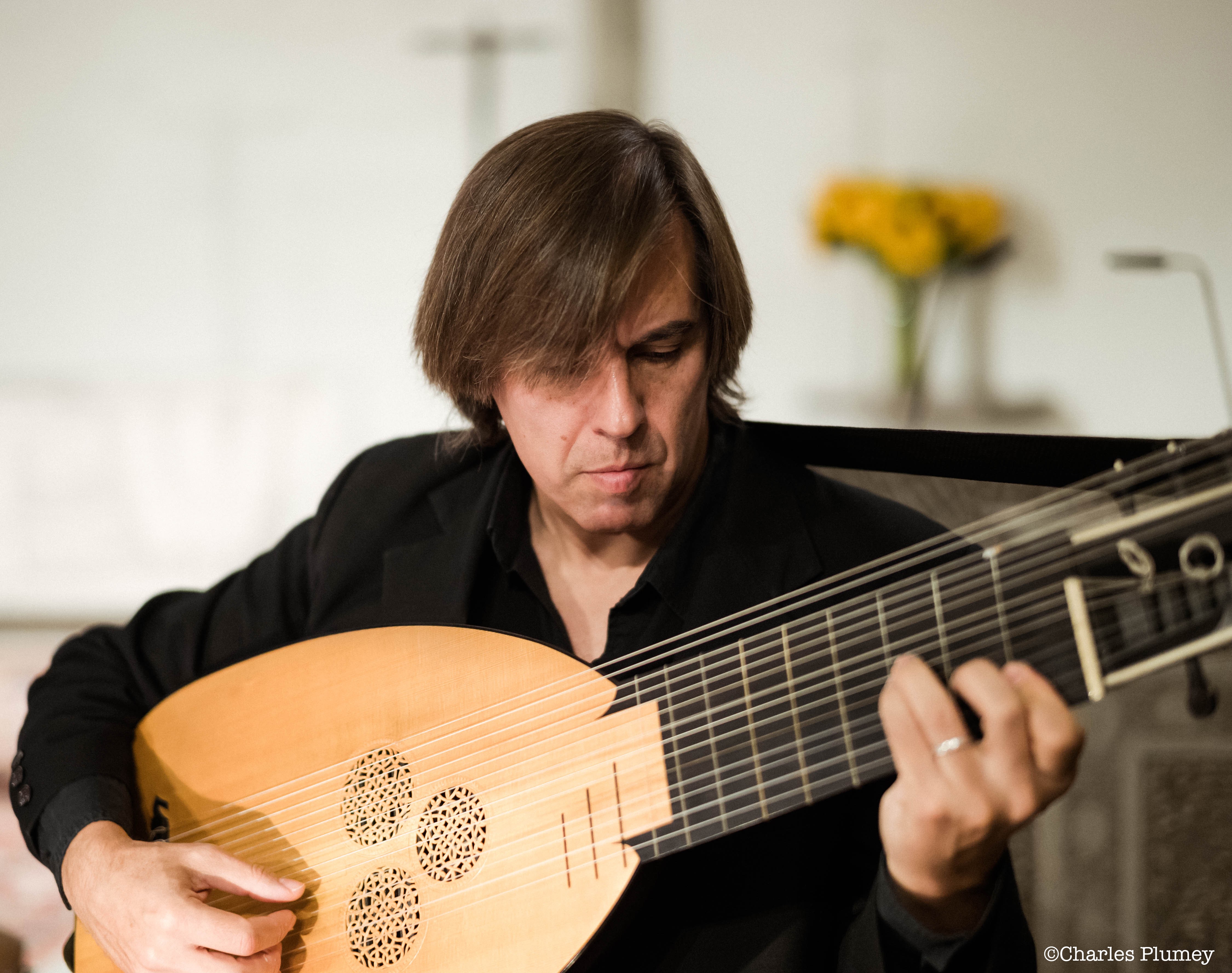
Born in Buenos Aires, Argentina, Quito Gato began his piano and guitar studies at the National Conservatory of Music. He then continued to perfect his skills in orchestral conducting, composition, flute, and percussion in his home country, and later in Santiago de Chile, Brazil, Curitiba, and Boston. Since 1992, he has been studying early music under the guidance of Hopkinson Smith and Eduardo Egüez. Since then, he has performed as a conductor, soloist, and member of various ensembles in major theaters in South America, the United States, and Europe. He has toured extensively in Asia to promote Spanish-American Baroque music in Israel, Malaysia, Thailand, Indonesia, and India. In 2020, he received a master's degree in performance from the Geneva University of Music under the guidance of Monica Pustilnik. He has participated in numerous chamber and orchestral music projects, and since 2007 has been one of the founders of Cappella Mediterranea. Since 2000, he has released numerous recordings of music from the Middle Ages to the Baroque, as well as works from the popular genre between the Mediterranean and Latin America for the labels Alpha, Ricercar, Naïve, Virgin, Cantus, and Sony. He regularly collaborates with renowned ensembles such as L'Arpeggiata, Le Concert d'Astrée, Les Musiciens du Louvre, Le Poème Harmonique, Le Concert de la Loge, and The Rare Fruits of Council, among others. He has performed in the world's greatest theaters and festivals, including Lincoln Center & Carnegie Hall, New York, Aud. He regularly collaborates with renowned ensembles such as L'Arpeggiata, Le Concert d'Astrée, Les Musiciens du Louvre, Le PoèmeHarmonique, Le Concert de la Loge, and The Rare Fruits of Council, among others. He has performed in the world's greatest theaters and festivals, such as Lincoln Center & Carnegie Hall, New York, Auditorio Nacional de Madrid, Palau de la Música Catalana, Barcelona, Radio France Auditorium & Opera Garnier, Paris, Teatro Colón, Buenos Aires, and Teatro alla Scala in Milan. He has given masterclasses in lute and early music in Argentina, Brazil, France, Italy, and South Korea. As a composer and arranger, he has worked for various institutions such as Radio France, the Gulbenkian Foundation, RTVE Spain, and artists such as Sonya Yoncheva, Anne-Sophie von Otter, Nuria Rial, Philip Jaroussky, Kristina Plukhar, Leonardo Garcia Alarcon, and others. Since 2021, he has been a professor of lute and chamber music at the Cité de la Musique et de la Danse - Conservatory in Strasbourg, France.